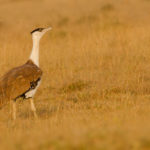
The Great Indian Bustard is one of the heaviest flying birds on Earth and one of India’s most critically endangered species. Fewer than 150 individuals survive in the wild today, confined largely to the arid grasslands of Rajasthan. It is the state bird of Rajasthan and a flagship species for grassland conservation across the Indian subcontinent.
What Is the Great Indian Bustard
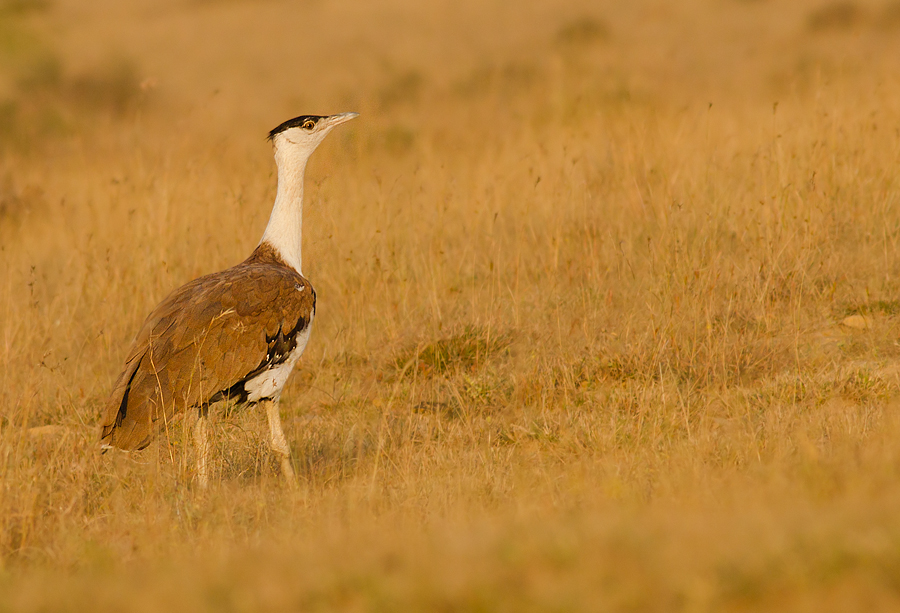
The Great Indian Bustard (Ardeotis nigriceps) is a large ground-dwelling bird of the family Otididae. It stands close to one metre tall and weighs up to 15 kilograms in males, making it among the heaviest of all flying birds in the world. The male carries a distinctive black crown, a broad black breast band, and pale buff-brown plumage across the back and wings. The female is smaller, with a less prominent breast band.
The bird was once widespread across the Indian subcontinent, ranging from Punjab and Rajasthan in the north to Andhra Pradesh and Karnataka in the south. Today its range has collapsed to a handful of sites, the most significant of which is the Desert National Park in the Thar desert of western Rajasthan, near Jaisalmer.
The IUCN classifies the Great Indian Bustard as Critically Endangered. The species is listed on Schedule I of India’s Wildlife Protection Act 1972, offering it the highest level of legal protection. It is also listed on Appendix I of CITES.
Where the Great Indian Bustard Lives
The Great Indian Bustard is a bird of open country – dry grasslands, scrublands, and semi-arid plains with low thorny vegetation. It avoids dense forest and cultivated fields, though it will move through agricultural areas where fallow land and grass patches remain. It needs large, undisturbed areas of ground to move, forage, and breed. Fragmented or fenced landscapes do not suit it.
The core surviving population lives within and around Desert National Park, a 3,162 square kilometre protected area in Jaisalmer and Barmer districts of Rajasthan. Smaller populations persist in the Naliya grasslands of Kutch in Gujarat, and isolated individuals have been recorded in Maharashtra, Karnataka, and Andhra Pradesh, though breeding is no longer confirmed at most of these sites.
The Thar desert habitat the bird occupies is not empty sand. It is a mixed landscape of stabilised dunes, grassland, Prosopis scrub, and seasonal wetlands – a complex ecosystem that the Great Indian Bustard has evolved alongside over thousands of years.
Diet and Behaviour of the Great Indian Bustard
The Great Indian Bustard is omnivorous and opportunistic. It eats insects – grasshoppers, beetles, and locusts form a large portion of its diet during the monsoon months. It also takes lizards, small rodents, and berries, and feeds on grass seeds during the dry season. This dietary flexibility is an adaptation to the seasonal scarcity of the Thar desert.
The bird is generally solitary outside the breeding season. Males are territorial and use a slow, deliberate display walk – neck extended, breast pouch inflated – to attract females and warn competing males. The call is a deep, resonant boom that carries across open ground. It is heard most often in the early morning hours of the breeding season, from March through September.
Unlike many other bird species, the Great Indian Bustard lays only a single egg per clutch, directly onto bare ground. Incubation lasts around twenty-six days and is carried out by the female alone. This low reproductive rate makes population recovery from decline very slow. A single breeding failure – caused by disturbance, predation, or collision – cannot easily be offset.
Why the Great Indian Bustard Is Critically Endangered
The population decline of the Great Indian Bustard is one of the most severe of any large bird in Asia. Surveys estimate the total wild population at fewer than 150 individuals, with some counts as low as 100 to 130 birds. The causes are well documented.
Habitat loss is the primary driver. The arid grasslands of India have been converted to agriculture, solar energy farms, and irrigated cropland at a rate that has left the Great Indian Bustard with a fraction of its former range. India’s grasslands are among the least protected habitats in the country – they are often classified as wastelands and given low conservation priority compared to forests.
Overhead power lines are now the single largest direct cause of mortality. The Great Indian Bustard has poor frontal vision due to the position of its eyes and cannot detect cables in time to avoid them. Birds strike high-voltage transmission lines and die immediately or from injuries. The proliferation of power infrastructure across Rajasthan for the renewable energy sector has dramatically increased collision risk in the bird’s core habitat. A Supreme Court order in 2021 directed the undergrounding of high-voltage lines in priority bustard areas, though implementation has been slow and contested.
Unregulated hunting reduced populations heavily through the twentieth century. Hunting is now illegal, but poaching continues to be reported at low levels.
Disturbance at nesting sites – from livestock, off-road vehicles, and human activity – causes nest abandonment. The bird’s single-egg clutch strategy makes every failed nest a significant loss.
Predation by feral dogs and foxes takes eggs and chicks at a rate that struggling populations cannot sustain.
Conservation Efforts for the Great Indian Bustard
India’s conservation response to the Great Indian Bustard’s decline has intensified significantly in the last decade, though many conservationists consider it insufficient given the pace of decline.
Desert National Park remains the most important protected landscape for the species. The park and its buffer areas in Jaisalmer and Barmer hold the largest surviving population and are the focus of most monitoring and protection work.
Project Great Indian Bustard, launched in 2015 by the Wildlife Institute of India in partnership with the Rajasthan Forest Department, established the first captive breeding programme for the species. Eggs are collected from the wild and hatched in controlled conditions. Chicks are raised in captivity and prepared for eventual release into protected grassland. As of 2024, the programme had successfully hatched and raised several dozen birds, a significant achievement for a species with a naturally low reproductive rate.
The Supreme Court ruling of 2021 on power line undergrounding in Great Indian Bustard habitat was a landmark legal intervention. Its full implementation would substantially reduce collision mortality in the Jaisalmer and Barmer areas. Progress on the ground has been uneven.
Community-based conservation efforts in Kutch and parts of Rajasthan have worked with local pastoral communities – particularly the Fakirani Jats of Kutch – to protect nesting sites, reduce grazing pressure at critical times, and build local awareness of the bird’s status.
International partnerships with Dubai’s Environment Agency and the International Fund for Houbara Conservation have brought expertise in bustard husbandry and captive breeding from programmes involving the related houbara bustard.
How to See the Great Indian Bustard
The only realistic location for a wild sighting of the Great Indian Bustard is the area around Desert National Park in Jaisalmer district, Rajasthan. The Sam and Sudashri areas within and around the park offer the best habitat. Early morning visits between November and March give the highest chance of sightings, as birds are more active in the cooler hours.
A guide with specific knowledge of current bird locations is essential. The Great Indian Bustard is wary, wide-ranging, and present in very low densities. Without experienced guidance, a visitor can spend days in the right habitat and not encounter one.
The breeding centre at Sam, run by the Wildlife Institute of India, is not open to public visits, as disturbance to captive birds is managed strictly.
Sightings should be reported to the Rajasthan Forest Department and the Wildlife Institute of India. Citizen science records contribute meaningfully to population monitoring for a species that is genuinely difficult to survey.
Quick Facts
| Feature | Details |
|---|---|
| Scientific Name | Ardeotis nigriceps |
| Family | Otididae |
| IUCN Status | Critically Endangered |
| Wild Population | Fewer than 150 individuals (2024 estimate) |
| Height | Up to 1 metre |
| Weight | Males up to 15 kg |
| Range | Rajasthan (core), Gujarat, Maharashtra, Andhra Pradesh, Karnataka |
| Habitat | Arid and semi-arid grasslands, scrublands |
| Diet | Insects, lizards, seeds, berries |
| Breeding Season | March to September |
| Clutch Size | One egg |
| Legal Protection | Wildlife Protection Act 1972, Schedule I; CITES Appendix I |
| State Bird Of | Rajasthan |